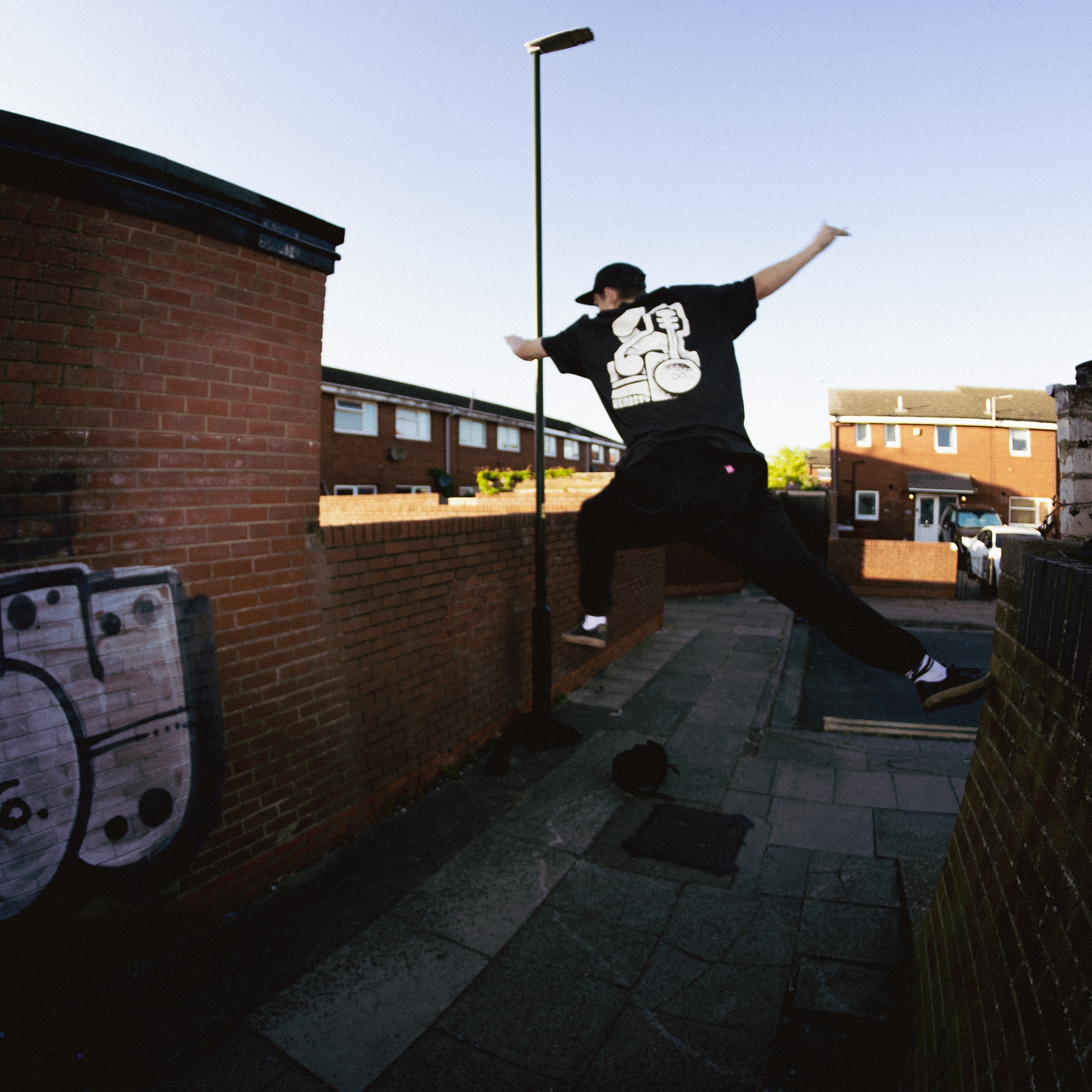
For those of you who may not know (which I'd imagine is most people reading this), my name's Charlie. Around a decade ago I was a professional parkour athlete. I travelled around most of Europe and North America attending events, leading workshops and competing. I had the support of a professional team (Storm Freerun, for any old-heads) which functioned as an agent, allowing me to do some commercial work on the side. Nowadays, I have parkour as a hobby alongside my career — but I still remain active in the parkour community, and I continue to work in the industry through my role at Parkour UK.
As I mentioned, I spent most of my teenage years travelling around events and competing. In fact, my coach at the time, Tom Taylor was the first coach to integrate strength training and proper periodisation to our conditioning programme. With the support of my coach and the team, I was lucky enough to have the chance to compete at some of the best parkour competitions the sport has to offer — I even commentated the livestream of SPL, before jumping out of the booth to compete! Although I may be nothing more than a retired unc relegated to a desk job at the sport's national governing body, I couldn't resist having a crack at competing again at this year's inaugural British Parkour Championships (after some words of encouragement from our CEO, Sam). What follows is a reflection of my experience from multiple angles. Hopefully, through my eyes, you'll be able to more clearly see the value that this event as to offer to our community.
For the past few months, part of my work at Parkour UK has involved helping to organise the first official British Parkour Championships, held in August at Street Monkeys. After spending so long talking about the event, planning around it and watching it gradually take shape, it was slightly surreal to finally arrive at the weekend itself.
I ended up experiencing the Championships from just about every angle possible. Across the weekend I helped commentate, conducted athlete interviews, judged the skill competition qualifier and helped coordinate our brilliant group of Parkour UK ambassadors. Somewhere in amongst all of that, I also competed in the style competition myself.
Unsurprisingly, working an event and competing in it at the same time imposes some fairly interesting constraints. My preparation mostly consisted of periodically disappearing from whatever I was doing, trying to warm up, competing, and then immediately returning to work. It wasn’t exactly the carefully controlled pre-competition routine of an elite athlete.
It was also my first competition in quite a while, and I hadn’t actually trained properly since May. Fortunately, the work with my coach, Harrison Fernandez (who also podiumed in speed) has put into keeping me strong, mobile and generally held together over the past year meant that I could still play to my strengths. I made it through qualification, the semi-final and eventually into the final, where I was able to complete three tricks I’d never completed before. Given the preparation, or lack thereof, I’m extremely happy with that.
Competing at the British Championships provided me with a new perspective on competition as a whole, and my place in it as a retiree. For the past few years, I've been trying my best to support the growth of a small team from my neck of the woods (Devon), Turf Cam. So when the British Champs came around, I reached out to the boys and suggested that they compete. Well, not only did one of the boys George Prior come and compete, but he went and won the style comp!
I consider myself Turf Cam's unc. In many ways I see myself as I saw my coach, Tom Taylor when I was a teenager. What the British Championships offered me was a chance to be on the course with George, who hadn't competed at an adult national level before. Although we are all technically competing against each other, parkour competitions are highly collaborative. We all want to see each other succeed. So having the chance to share practice time with George, to help guide his decisions on which tricks to put where and to be a friendly face on the course during the comp was a surprising highlight of the competition for me. It made me realise that I enjoy the experience of competing and I want to be able share that love for competing with the next generation.
What's more, competing gave me an unexpectedly useful perspective on the event itself.
One of the interesting things about working in sport is that it’s very easy to discuss competition formats abstractly. You can design scoring systems, qualification structures and judging criteria on paper, but ultimately the important question is whether those systems actually produce a competition that rewards the athletes who perform best. Having now experienced the style competition from the inside, through all three rounds, I have a much better understanding of where the format works and where I think it can improve.
There is definitely room to grow. That’s inevitable for the first iteration of an event like this, and I’d probably be more concerned if we came away thinking there was nothing we could do better next year. But the most important thing is that, when the competition was over, the podium reflected the athletes who had performed best across the weekend. For a first Championships, that’s a pretty important measure of success.
I also came away from the weekend thinking about my own relationship with parkour.
Over the last few months, I’ve felt increasingly disconnected from training. I haven’t really trained since May, but the lack of training has felt more like a symptom than the problem itself. I’ve been slightly disinterested in it, without a particularly strong idea of what I want to work towards when I do train. When you’ve spent such a large portion of your life doing something, it’s strange when the motivation that used to feel automatic suddenly isn’t there.
Competing this weekend reminded me of a period when that wasn’t the case.
I think I was at my best — and, probably more importantly, enjoying training the most — when my training had structure. Working under the tutelage of @movementpower gave me clear goals, things to improve and a reason for individual sessions to exist beyond simply turning up and seeing what happened. There was a sense of progression that I think I’ve been missing recently.
The Championships reminded me how much I enjoy having something to work towards. Making the final was nice, but the more valuable part was the process of having to think about what I could do, how I wanted to perform and what I wanted to achieve. Even with almost no recent parkour training, suddenly there was a reason to move.
As the year progresses, I think reintroducing some of that structure could be important for my relationship with the sport. Not necessarily because I need to become a serious competitor again, or because every training session needs to be optimised towards some grand objective, but because I’ve realised that completely unstructured training doesn’t necessarily give me the freedom I assumed it would. Sometimes a goal is what makes training fun.
Perhaps that’s also why I came away feeling so positive about the Championships more generally.
Parkour has traditionally had a slightly complicated relationship with formal competition, and understandably so. One of the things that makes the sport special is the freedom athletes have to decide what progression means to them. Competition shouldn’t replace that. But I don’t think structure and freedom have to be opposites either. A well-designed competition gives athletes another context in which to test themselves, another reason to develop their movement, and another opportunity for the community to come together around what people are capable of.
This weekend felt like a very good example of that.
More than anything, it was just incredibly cool to see so many people in one place, taking the competition seriously while still retaining the atmosphere that makes parkour events enjoyable in the first place. Putting something like this together takes an enormous amount of work that spectators — and often competitors — never see, and I’m very grateful to everyone who gave their time to make the first British Parkour Championships happen.
A huge thank you to our ambassadors and volunteers, to everyone at Street Monkeys, to Ben Lynch, Seans Delaney and Newsham, and to our incredible CEO Sam. And, of course, to every athlete who turned up and trusted us enough to compete in the first version of something we’re hoping to build for years to come.
There are plenty of things to learn from this year, and plenty of things I think we can make even better next time — and that’s exciting!
For me personally, the weekend also provided something I wasn’t necessarily expecting: a reminder that I might not be finished with competing — or with structured training — quite yet.
I think the community will benefit enormously from having competitions like this to work towards. Apparently, I might too.
Already looking forward to seeing what year two looks like.
.jpg)