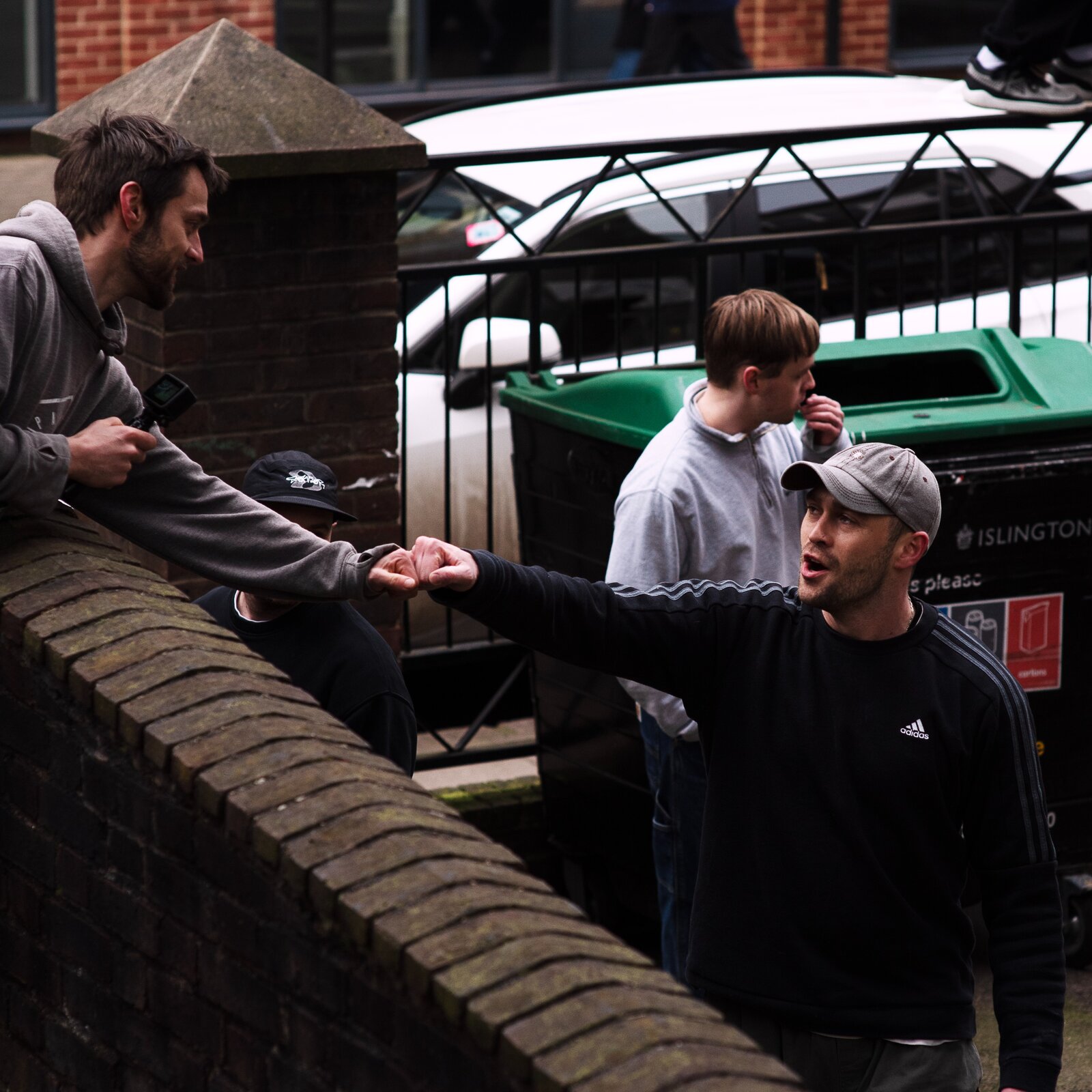
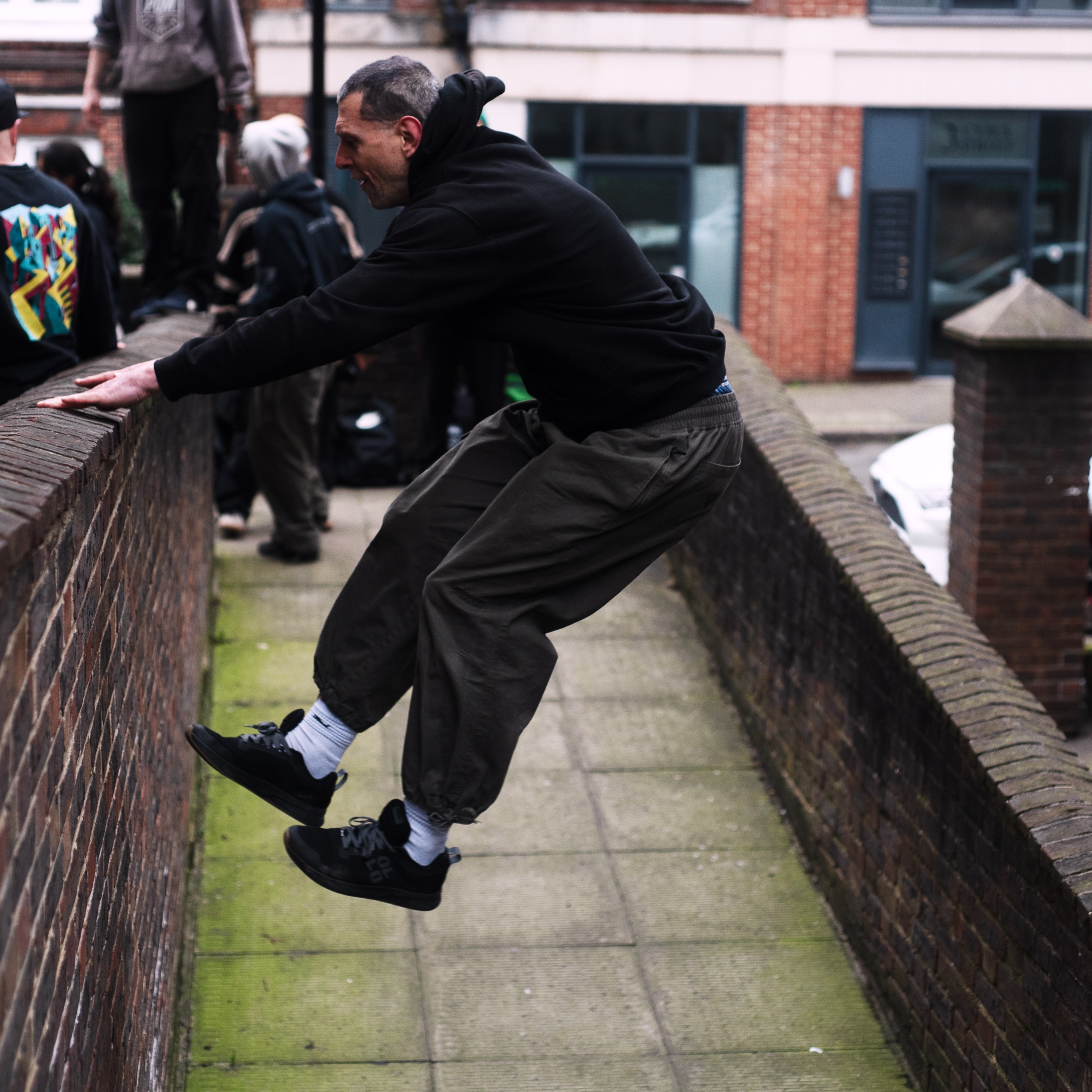
Tom Taylor travelled to the World Championships in Brno in November 2026 self-funded and unofficial. He went mainly to support Ed Scott, one of the biggest names in the sport and an athlete Tom coached as a young competitor. He came home as part of a coaching team that stood out from every other nation’s. We sat down with Tom for a post-comp debrief, where he told us about strategy, food shops, injuries and when to stay quiet, and about why he thinks coaching is the next big opportunity in competitive parkour.
Tom has been training parkour since 2004. Like many practitioners of his generation, he came to coaching by an indirect route. In 2008 he was injured, and the rehab exercises his physiotherapist gave him “really weren’t designed for athletes.” So he started reading for himself.
“That’s what gave me the start in understanding strength and conditioning for the sport,” he says. “The exercises I ended up doing made my parkour much better.”
He was already teaching workshops and classes now and then. Now he also had a growing understanding of how to improve performance. He began working with a group of athletes who wanted to train specifically for competition. When they started winning, something changed for him.
“I was always middling – top 10 nationally, top 20 internationally for speed. But when the guys I was working with started podiuming, and my online clients started winning too, the feeling I got from helping people actually outweighed any wins I would have had myself. If I can give someone a leg up, so they don’t have to go through years of trial and error and banging their head against the wall, that really motivates me.”
Tom’s route to Brno was unusual. He wasn’t selected by Parkour UK. He paid his own way, mainly to support Ed Scott. Ed is now one of the most recognisable names in competitive parkour, and Tom coached him as a young athlete during his rise to prominence. Their relationship goes back years. So when Tom gave Ed some advice from the sidelines at the British Championships finals, and it helped him win the deciding challenge, Ed asked him to come to Worlds.
“He basically said to me, ‘I’d completely forgotten what it’s like having somebody who knows me, who knows my ability, who knows how I work.’”
Once he arrived, Tom’s role quickly grew beyond one athlete. He stayed with George Pryor and supported him through the week. He also worked alongside Megan, Denny and Harrison, several of whom he had known for years. Head coach Tom Redfern and fellow coach Sean Newsham, both long-time friends from the competition circuit, welcomed him into the coaching team.
That welcome turned out to be one of the most powerful moments of the trip.
“I didn’t know whether I’d be accepted as part of the coaching team, because I was there specifically for Ed,” he says. “But when we took pictures as the coaching team, [Tom] Redfern and [Sean] Newsham insisted I was part of it, and made sure I was mentioned whenever we talked about the coaches. That really moved me. I actually had to go and have a bit of a cry about it.”
Because Tom was staying with Ed, he could support him at every stage of the competition. That meant strategy: choosing skills for the combo and flow rounds in style, and planning routes for speed.
“The fastest route might also be the riskiest,” Tom explains. “So we have to look at choke points, plan A, plan B, all of that.” It also meant practical jobs that are easy to overlook, like holding the phone while Ed filmed his skill challenges, or managing his rest, hydration and fuelling.
“He’d say, ‘Okay, I’m feeling this way, what can we do now?’ And it’d be, ‘Let’s get some sugar in you, let’s get some hydration.’ Or we’d get home and I’d say, ‘Right, you need calories right now.’”
Ed finished the championships with two first places and a third. Tom believes having dedicated, knowledgeable support beside him played a big part in that. One of Tom’s favourite memories, though, has nothing to do with podiums. The athletes’ travel was delayed, and they arrived in Brno late on the first night with no chance to eat. Tom had arrived earlier, so he did a food shop and cooked a huge meal. It was ready the moment they walked through the door.
“They could eat, get some rest, and be ready to go the next day,” he says. “That’s a big highlight for me.”
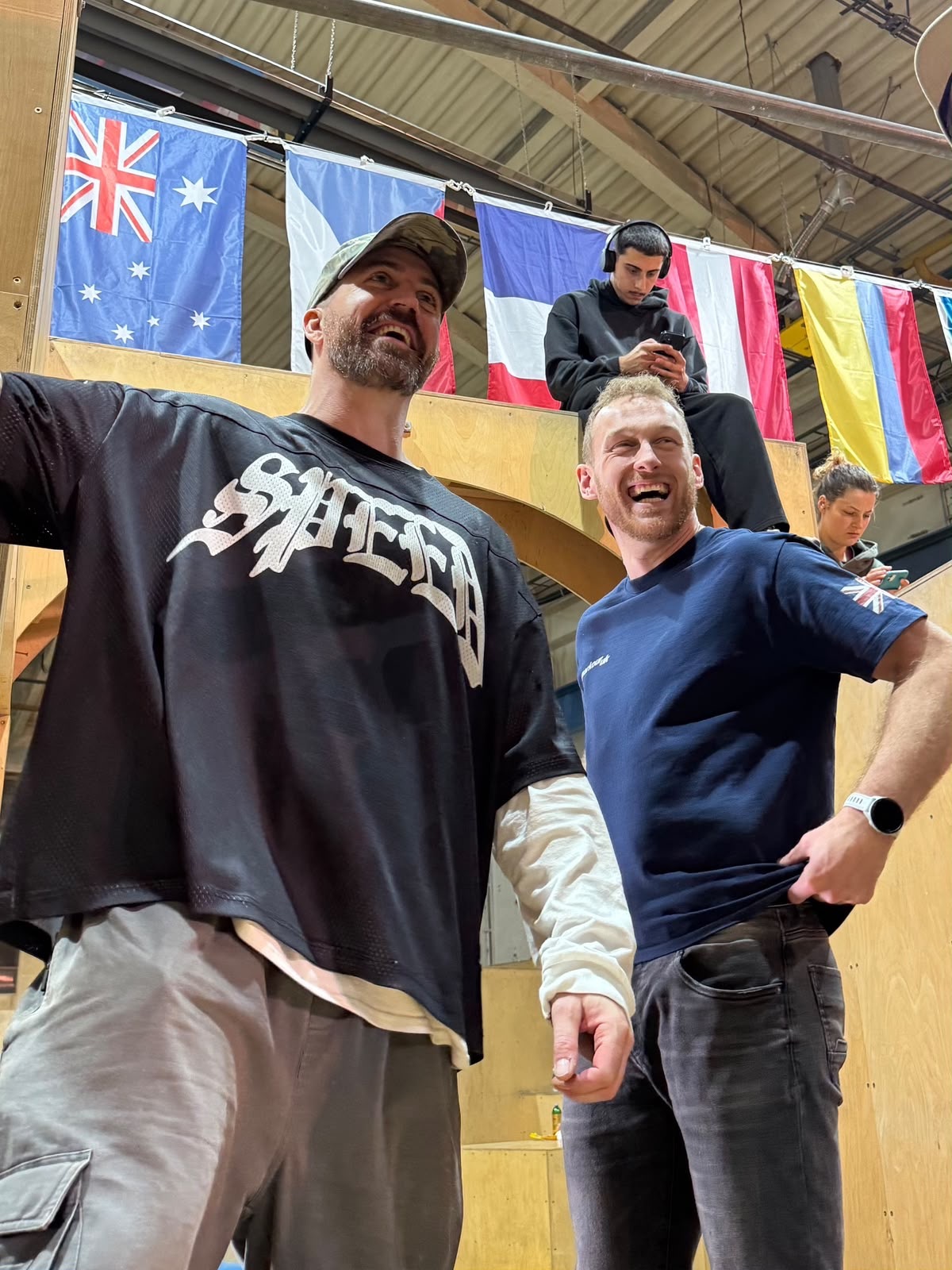 (Tom, left, pictured next to our head coach, Tom Redfern, right)
Supporting athletes also means being there when things don’t go to plan. When George was injured during the week, Tom helped him put it in perspective.
“It was about helping him realise this is a blip in his whole competitive career. In fact, it’s a good learning experience: how do I deal with this when it happens? And while you’re here in person, let’s watch everybody else.”
Tom says this is where the British team really stood apart. “We stood out against the other national teams because we had dedicated coaches supporting the athletes. You could see that reflected not only in their performance, but in how they dealt with things going wrong. They had a full team of people helping them with the physical side and the psychological side.”
Parkour has deep roots as a self-directed discipline, and Tom is very aware of what that means for coaching. For him, a lot of good coaching at elite level comes down to knowing when not to coach.
“There are points during competition where Ed is preparing himself mentally and needs to be left alone. A good coach knows when to talk to their athlete and when not to. You have to know their process to know how much is too much and how much is too little. Am I interrupting this person’s internal process with too many cues, too much encouragement, too much criticism? Or am I doing the reverse?”
He sees humility as central to that balance. “I don’t have perfect knowledge. I’m giving suggestions rather than commands, and there’s a huge difference between those two things.”
What a coach can offer, he argues, is an outside view. “It’s very easy for an elite athlete to look at a challenge, get really into the weeds with it and let their subjective perspective take over. Having a third party with an objective point of view, maybe different opinions or different information, is a huge advantage.”
For anyone hoping to coach at the highest level, Tom’s advice is simple: get experience, and lots of it. “If you’re an athlete, compete. If you’re a coach but not an athlete, be at as many competitions as possible.” In his first four years of competing, he went to around 20 events, many of them abroad.
He is honest that this is still early days. Paid coaches who travel with their athletes are only just starting to appear. “You’re probably not going to be funded when you start out. But competitions are getting bigger every year, there are more of them, and there’s plenty of opportunity for competitive parkour coaches.” Above all, he says, keep your humility. “You can’t just rock up and imagine you have all the information. Even with experience, you don’t know everything.”
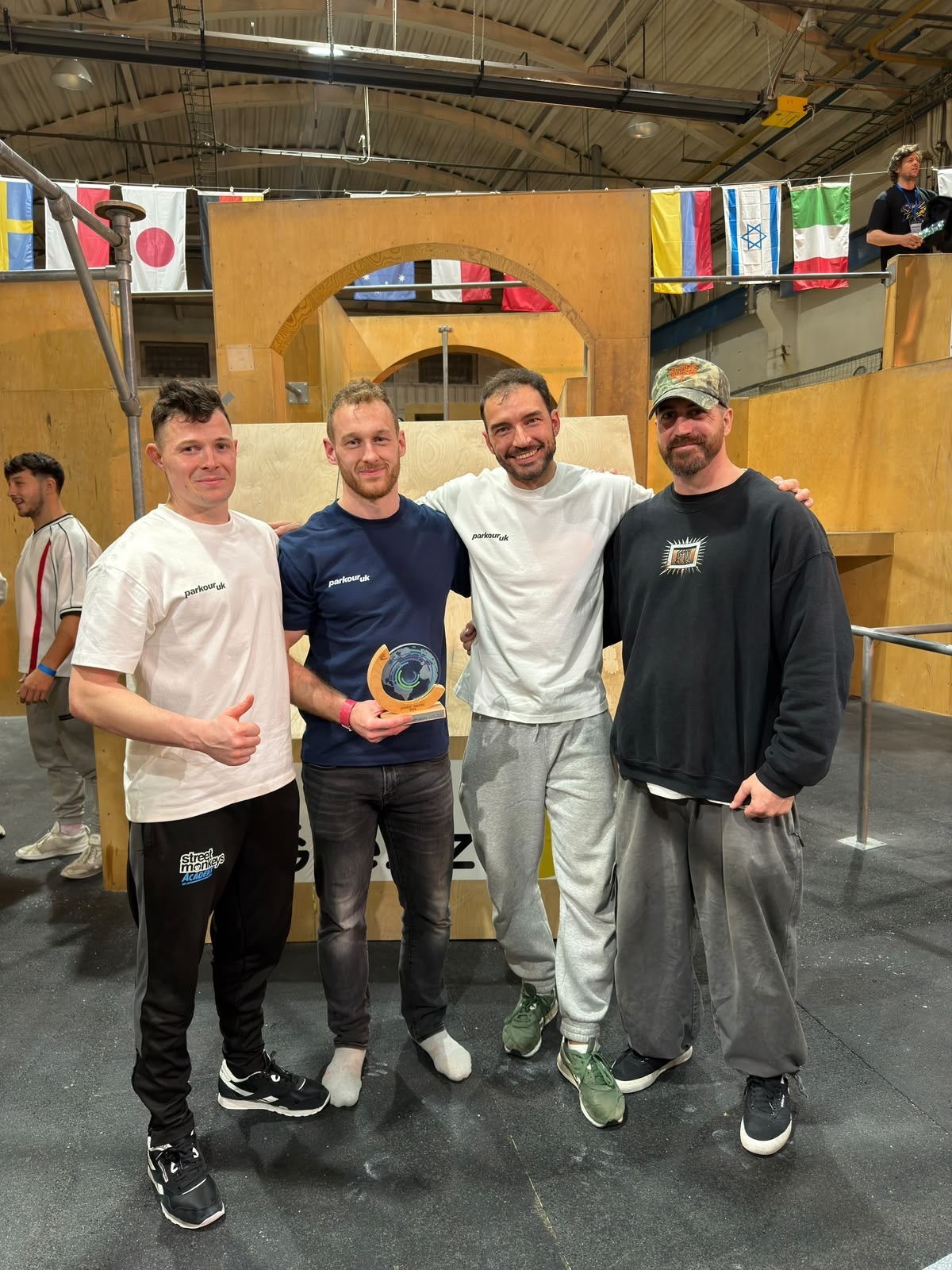
(Our coaching team, from left to right: Sean Newsham, Tom Redfern, Deni Stoynev, Tom Taylor)
The biggest lesson Tom took from Brno is how much room there is for coaching to grow. “Imagine if every national team had a dedicated coaching team. That would create such a spectacle and such a competitive atmosphere.”
He believes long-standing practitioners have a lot to offer here. They bring values that have shaped the sport since its early days: enjoying the process, not being overly competitive, and being driven from within as well as by results. Coaching also matters for athlete welfare, he says.
“Coaches help athletes get more performance out of themselves, in a safer way, because they have people advocating for their interests. Event providers need to balance the spectacle with safety and with pushing the sport forward. Advocacy for athletes is huge.”
He left as an unofficial coach and returned firmly part of the team. Asked what drives him, he puts it plainly: “It was a stressful week for me, because I love it. I want to be there for those guys and help them.”