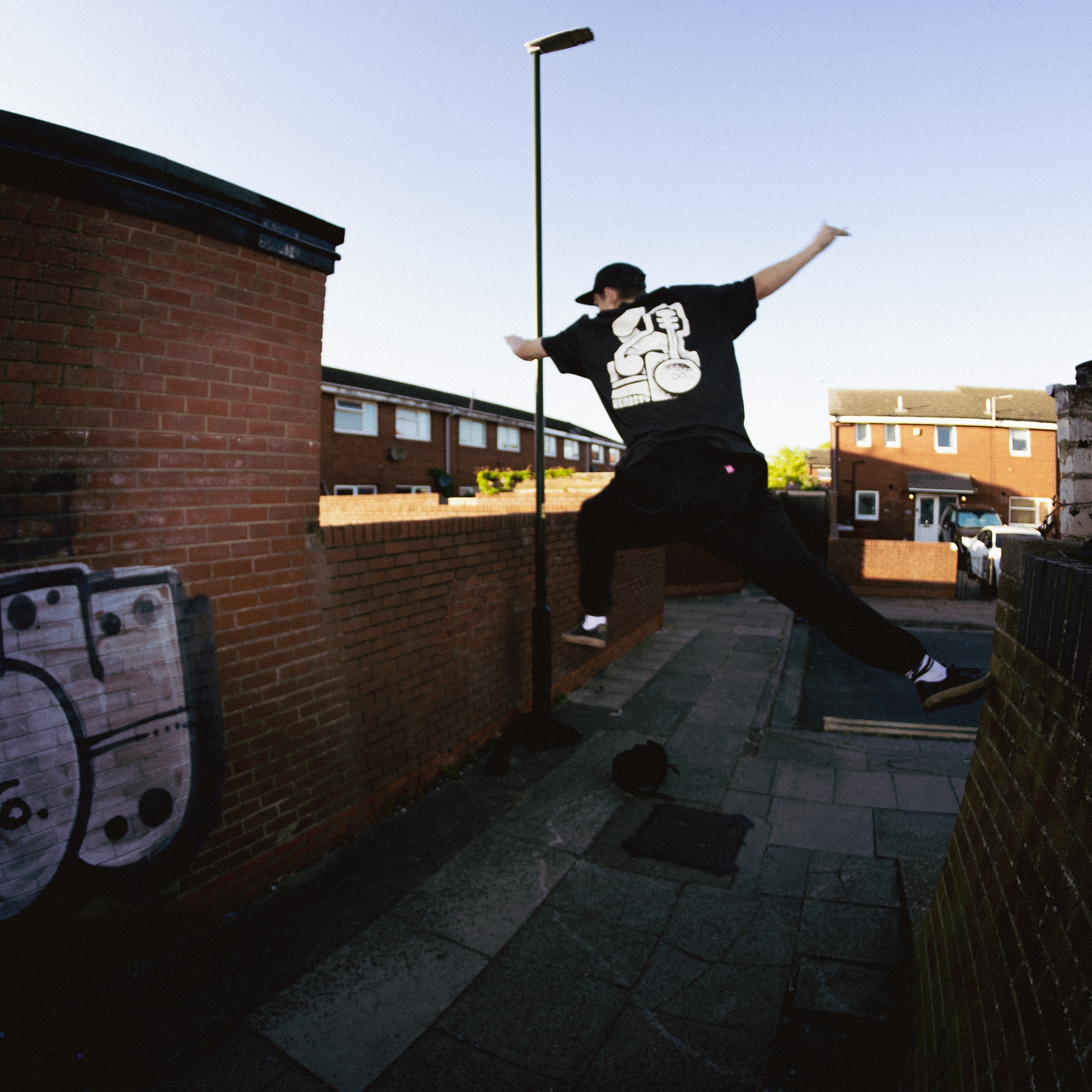
If your main exposure to parkour is through YouTube or Instagram, you could be forgiven for thinking it’s a young person’s sport. Huge gaps, increasingly technical flips and athletes who seem to bounce back from impacts that make the rest of us wince tend to dominate our feeds.
But that’s only one version of parkour.
Martin Clarke started training in his 40s. Four years later, parkour has made him stronger, given him new challenges to work towards and, perhaps most importantly, introduced him to a community he now considers one of the most rewarding parts of the sport.
Like a lot of people, Martin came out of the COVID lockdowns feeling the effects of spending too much time indoors.
“I’d spent way too much of lockdown not doing anything and watching way too much YouTube and becoming way too unfit,” he says.
Fortunately, some of that YouTube time provided the solution. After discovering videos from STORROR and other parkour groups, Martin was inspired to try it himself.
“I’d always been active and healthy, so lockdown hit me a bit on that aspect, and I just needed something new.”
He found Airborn Academy in Liverpool and started attending classes with Anthony Doyle. He was hooked almost immediately.
“I loved every second of it.”
Before parkour, Martin’s exercise had mostly revolved around endurance sports such as running and cycling. Parkour presented a completely different physical challenge, demanding more strength, mobility and flexibility.
Training in your 40s does come with some practical considerations, though.
“As you get older it takes a lot longer to warm up, and injury is always a worry,” Martin says. His advice on that front is simple: “Never skip a good warm-up.”
Four years of training has made Martin noticeably stronger and more athletic. But the biggest benefit hasn’t necessarily been physical.
“I think the big benefit is to really explore your own limits,” he says.
That process is familiar to anyone who has practised parkour for long enough. A jump or movement can initially seem impossible — or simply too frightening to attempt. You break it down, work on the individual components and gradually build the confidence to return to it.
“Some challenges can be very scary, and breaking it down and then coming back to complete it can be amazingly rewarding, and bring a lot of joy.”
One of Martin’s own challenges was the wall run, which took him nearly a year to prepare for. It’s an important reminder that progress in parkour doesn’t have to be measured against what somebody else can do. A challenge that takes one person an afternoon might take another person a year. Completing it can be just as meaningful.
That perspective also shapes how Martin thinks about getting older.
“I know that as I age more I won’t be as physically strong or fast, but if I keep having goals and keep having fun then it will keep me active and happy for a very long time.”
Part of the perception that parkour belongs to younger people may simply come down to visibility.
“There’s not a lot of older people putting out videos and Instagram isn’t as popular with anyone over 40, so we don’t get seen a lot,” Martin says.
But that doesn’t mean they aren’t training.
Martin points to practitioners such as Richard Marshall, who continues to train in his 60s, and Dale Hubbard, who only took up parkour in recent years at a similar age to Martin.
“There is a community now of older people doing parkour,” he says. “More are out there, and it’s getting more popular.”
Greater visibility could be an important part of encouraging more people to start. If the only parkour you encounter online is performed by highly experienced athletes in their teens and twenties, it can be difficult to imagine what starting at 40 might actually look like.
“As with any minority getting into the sport, it’s all about having positive role models people can relate to.”
There’s another misconception Martin would like to dispel: that younger practitioners might resent older people entering their spaces.
His experience has been exactly the opposite.
“There’s always huge positivity from the rest of the community when us old guys get involved. It’s great to see.”
Martin has completed plenty of challenges he once thought were beyond him. But ask him about his most rewarding experience in parkour and he doesn’t choose a particular jump or movement.
It’s the people.
“The most rewarding experience is definitely being a part of this awesome community which we’ve built,” he says.
“There’s so much positivity and support that even doing a small challenge people will always celebrate and be happy for me.”
It’s also why Martin is reluctant to position himself as someone with lessons to teach younger practitioners. As somebody still relatively new to parkour himself, he thinks younger athletes are doing pretty well already.
There is one thing he would encourage, though: take opportunities for adventure when they appear.
“Your options will narrow as you get older, so make the most of life while you can.”
Fortunately, he thinks that’s something the parkour community already understands particularly well.
For somebody in their 40s watching parkour from the outside, getting started can seem intimidating. Martin’s advice is to remember that the spectacular version of the sport we see online isn’t the only way to practise.
“All you’ll see online is young kids doing massive gaps and crazy flips, but at its most enjoyable parkour is about exploring your environment and having fun.”
You don’t need to start with a huge jump. You don’t need to learn a flip. And you don’t need to measure yourself against someone half your age.
Find a local community or gym. Set challenges that matter to you. Take the time to prepare for them. And enjoy moving.
“Just give it a go,” Martin says. “Get involved with the community or a local gym and just go have some fun.”
After all, as Martin puts it, the challenges are only part of what makes parkour worthwhile:
“Doing this alone would be nothing. Being part of the community is everything.”




.jpg)