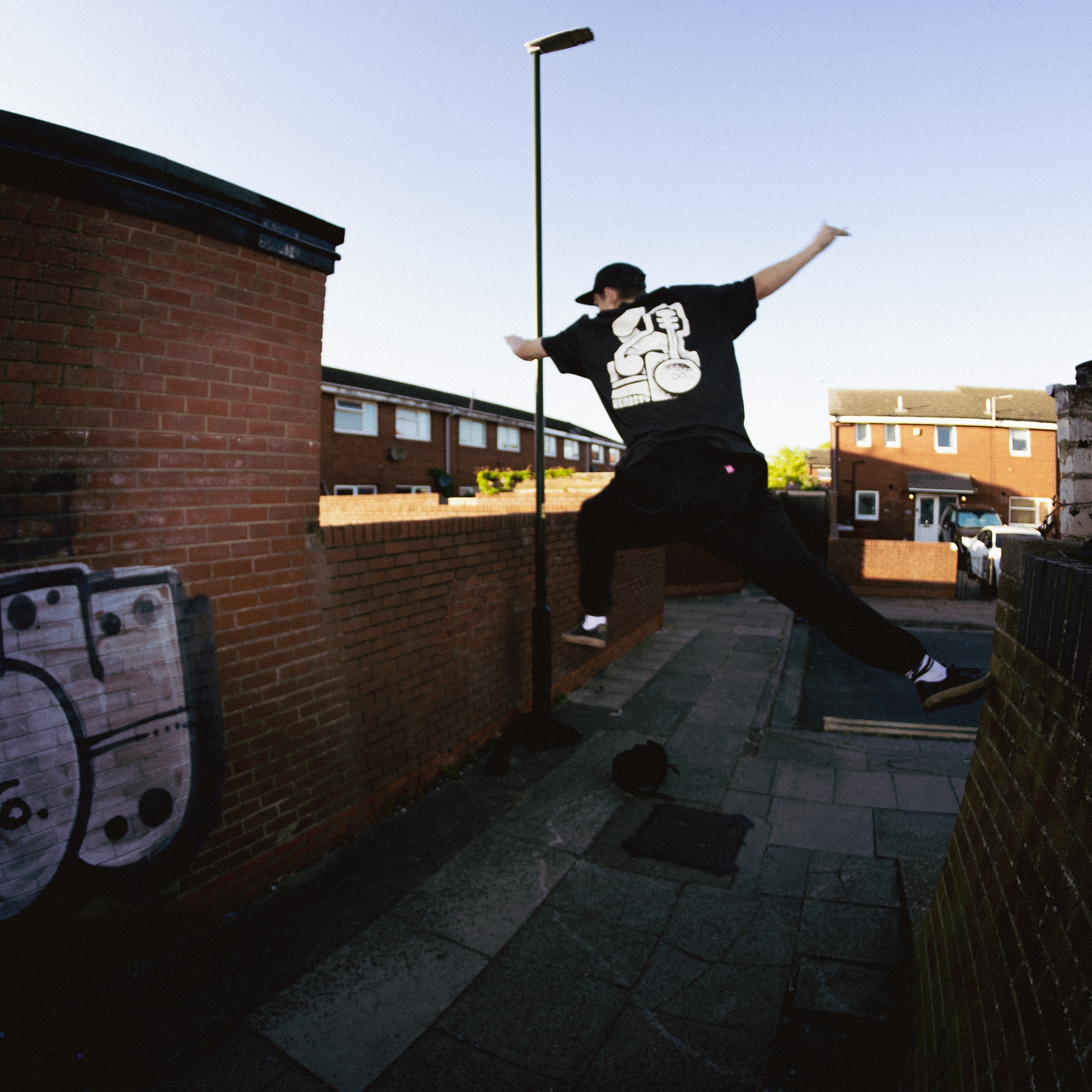
Hazal Nehir is a professional parkour athlete and Red Bull athlete, known for pushing the limits of the sport both physically and mentally. She was the first Turkish athlete to reach the Red Bull Art of Motion finals and has worked as a stunt performer in the film and television industry.
In this guest post, Hazal writes about a different side of parkour: what happens when your body knows what to do, but your mind gets in the way — and how a serious fall led her to discover an unexpectedly simple way of getting out of her own head...
Everything started in 2023 after my capstone fall. After having two surgeries and four months of physiotherapy, I found myself back in parkour. But my parkour training looked different this time. I was still recovering from the fall, so it was still affecting me mentally and physically. I was obsessed with getting back to parkour and reaching the level where I had left off. During the recovery process, I had plenty of time to think about how the fall happened and why it happened. It was pretty clear in my mind why it happened, and it was not the first time I had made that mistake. However, this time the mistake had serious consequences, and I was suffering because of it.
Six months after the fall, one day I was training on rooftops, and that session made me realize that I was quite scared of being exposed to heights, taking risks, and falling. Training was no longer fun. It was the moment I realized that I couldn’t train like this scared and hesitant. So, I decided to take control of my recovery and my return to parkour. I approached training as an environment where I could learn more about my mental state. After successfully managing this journey, in 2024 I found myself at a level I would never have imagined. I was mentally and physically stronger than before. As I got back to doing high level parkour again, it was time to put the practice what I had learned from my mistake. I needed to work on the skill I lacked so I could fully trust myself again. The mistake I made was being too much inside my head instead of being present. I guess I was present in my thoughts, but not in the movement itself. Clearly, being too aware of your thoughts during high consequential movements is not the best thing to do.
I started thinking about how I could train this skill, and then I saw a video from the WHAT guys in Spain. They were attempting a challenge called “Infinity Strides.” There were over 100 beams placed one meter apart from each other above a canal, and the goal was to complete all of them. As soon as I saw that challenge, I knew it was the perfect practice: being able to stay focused for a long period of time in a high consequence environment. So I traveled to Spain. When I arrived at the spot, there was no water in the canal. Instead, it was a 2.5-meter drop onto concrete. This completely changed the consequences. My first couple of warm ups at the spot went well, but the more I practiced, the more my brain started to freak out. The consequences no longer felt worth the challenge, and my brain was trying to protect me. I was not able to control it, and it was starting to become dangerous.
I came back a couple of hours later to try it again. This time, while I was warming up, I started counting the strides, and suddenly I realized that it was helping me stay focused. It almost felt like my brain didn’t have time to freak me out because it was busy with the counting, so I started counting every step. If I got confused with the counting while doing the strides, I would restart counting from one and continue. It was really interesting.
After I got back from Spain, in 2025 I found myself interested in another challenge: the iconic Brighton wall run. I started putting pressure on myself to try it because I had wanted to do it for the last four years. As no woman had ever attempted running up it before, I wanted to become the first woman to do it.
After putting in some practice, I went to the spot. Most of my preparation felt really good, but there was one thing still on my mind. The Brighton wall run is a challenge that requires 100% commitment and no hesitation. If you hesitate in the middle of the wall, the worst case scenario might happen. So I wanted to make sure I wasn’t doing anything stupid on the wall. Then I remembered the counting technique and how it had helped me stay in the zone. I thought I could use the same technique to make sure I kept running on the wall. During my preparation, I counted my last three steps before takeoff ‘1, 2, 3’ but it didn’t work. Something felt off. Still, I knew the technique had worked before. Then I realized that, for the Brighton wall run, the last three steps before takeoff needed to be quick because it was more of a sprint. But with the strides, the steps are more extended , you spend more time in the air then sprint ,so the rhythm was completely different. I realized that strides and sprinting have two different rhythms. For the Brighton wall run, I needed something quick and repeatable rather than counting. That’s when I decided to say to myself, ‘Go, go, go,’ to match the rhythm of my steps. I practiced saying it during the preparation, and it felt really good. Now I was ready to commit. There was nothing in my mind that I was questioning about the challenge. I felt %100 ready, and it went perfect.
After successfully doing the Brighton wall run, I started using this technique as a mental tool I could rely on. I realised you can only rely on this technique if your body knows what to do %100. But the experience also opened the door to new questions. Why did the words need rhythm? What is the connection between self talk and quieting overthinking?
I found the whole experience deeply fascinating, and I’m excited to keep exploring and learning from it.