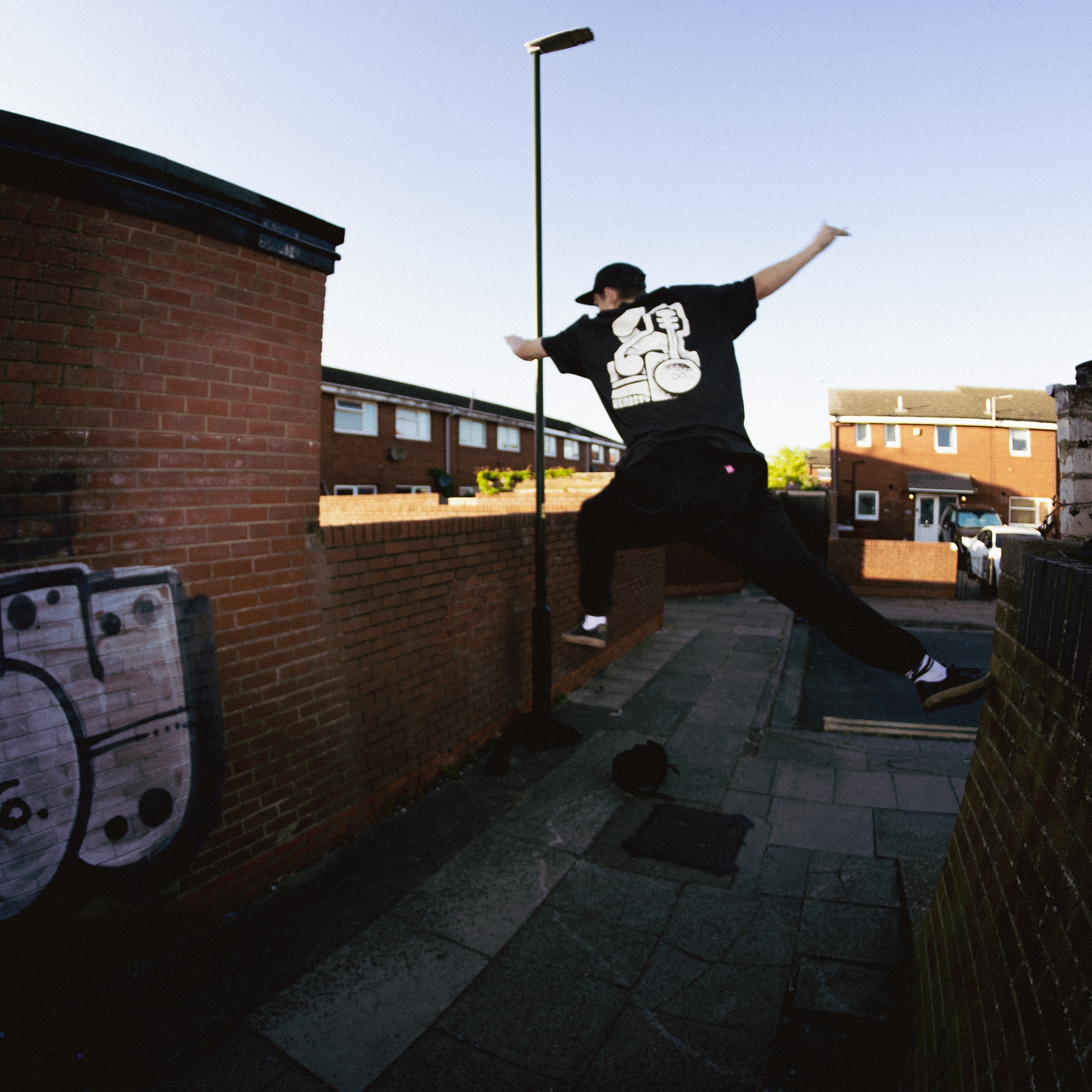
Many sports developed through competition. Organised contests came first, followed by governing structures, championships, and systems designed to identify and develop talented athletes. Over time, many of these sports expanded beyond competition itself, becoming vehicles for participation, community building, health, education, and social change. Parkour followed almost exactly the opposite trajectory. Long before there were competitions, there were practitioners gathering in parks, on university campuses, in industrial estates, and in city centres. The discipline spread through informal communities connected by a shared interest in movement, challenge, and self-development. Progress was measured not against opponents, but rather against obstacles, environments, and oneself. For many early practitioners, parkour offered an alternative to conventional sport rather than another version of it.
It is therefore unsurprising that the arrival of competition was met with scepticism. As parkour gained visibility during the 2000s, competitions began to emerge alongside the growing international community. Events such as Red Bull’s Art of Motion brought practitioners before judges, audiences, and cameras for the first time, prompting debate about whether competition was compatible with a discipline rooted in self-development and personal challenge. Many feared that rankings, prizes, and public recognition would undermine the values that had shaped parkour’s growth. Others questioned whether a practice built upon creativity and exploration could ever be meaningfully reduced to scores and podium places.
Yet while these debates continued, competition continued to evolve. Throughout the 2010s, a diverse range of events emerged across Europe and North America, each experimenting with different formats and approaches. Some prioritised spectacle, others sought to preserve the atmosphere of a community gathering, but together they helped establish a distinctly parkour approach to competition. Looking back, what is perhaps most striking is that many of the fears surrounding competition did not come to pass. While competition undoubtedly influenced the development of parkour, it did not displace the wider culture from which it emerged. Instead, it became another expression of that culture, shaped by the values and communities that had existed long before the first competitions appeared.
Competition undoubtedly influenced the development of parkour. It created opportunities for athletes, increased public visibility, and introduced new pathways within the discipline. Yet it did not displace the wider culture from which it emerged. The most successful competitions tended to be those that remained connected to the values of the community itself. Athletes continued to support one another. Competitors shared knowledge with rivals. Events became opportunities not only to perform, but also to reconnect with friends, exchange ideas, and strengthen relationships across communities. In many cases, competitions retained something of the atmosphere of the jam, while adding the challenge and excitement of performance under pressure.
This history helps explain why competition occupies a distinctive place within parkour today. Whereas many sports were founded through organised competition and later developed broader social purposes, competition emerged within parkour only after the culture, values, and community of the discipline were already established. As a result, competition has often been understood not as an end in itself, but as a means of supporting the wider development of parkour.
For many within the parkour community, the value of competition extends far beyond the identification of winners. Competitions provide a platform through which parkour can be shared with a wider audience. They offer a visible expression of the creativity, resilience, problem-solving, and mutual support that characterise the discipline at its best. Exceptional athletic performances may attract attention, but their significance lies in what they reveal about the culture from which they emerge.
This is particularly important at a time when many people struggle to find forms of physical activity that feel meaningful, accessible, or welcoming. Physical inactivity remains one of the most persistent inequalities within modern society. Many people spend years believing that sport simply is not for them.
Parkour offers a different possibility: at its most fundamental level, parkour requires very little — it can be practised almost anywhere and adapted to a wide range of abilities and ambitions. Some are drawn to its athletic challenge, others to its creativity, others to the sense of community it provides. What unites these experiences is the opportunity to confront challenge, develop confidence, and push our respective capabilities.
From this perspective, competition serves a broader purpose. It provides a means through which parkour can reach new audiences, challenge misconceptions, and demonstrate the positive contribution it can make to people's lives. Its success is measured not only by the quality of the performances it produces, but also by its ability to communicate what parkour is and what it has to offer.
This understanding informs Parkour UK's approach to competition and, in particular, to the British Parkour Championships.
The Championships are not intended to replace the many excellent events that already exist throughout the United Kingdom and beyond. Competitions such as Project Underground, local takeovers, gym events, and international competitions such as Sports Parkour League all make important contributions to the growth and development of the sport. Each serves a different purpose and reflects different aspects of the wider parkour community. The British Parkour Championships should therefore be understood as part of a broader ecosystem rather than as a competitor to it. The continued growth of multiple events, organisers, and opportunities is a sign of a healthy and developing discipline.
At the same time, the Championships occupy a distinctive position within that landscape. As a national championship, they provide a focal point for the British parkour community and a pathway towards international representation. Through Parkour Earth's developing international competition structure, the Championships will help identify athletes who may go on to represent Great Britain on the world stage. In doing so, they contribute to a wider effort to ensure that parkour continues to shape its own future through organisations and structures that emerge from within the discipline itself.
Like the best gatherings within parkour, the British Parkour Championships are ultimately about bringing people together. They provide an opportunity for athletes, coaches, volunteers, spectators, and communities from across the country to share in a common experience. For some, the weekend will be defined by competition. For others, it will be an opportunity to reconnect with friends, discover new ideas, and celebrate the remarkable diversity of movement that exists within contemporary parkour.
In this sense, the British Parkour Championships are not solely a sporting event. They are a reflection of how parkour has evolved over the past two decades: from an activity that once questioned whether competition had any place within it, to a discipline capable of embracing competition while remaining true to the values that shaped the sport.
Competition will never define parkour in its entirety. The future of the discipline will continue to be shaped by local communities, informal practice, coaching, creativity, and the countless individual journeys that take place away from public view. Yet competition has become an important part of that story.
The British Parkour Championships represent an opportunity to celebrate that story, contribute to its next chapter, and share it with a wider audience than ever before.

.jpg)