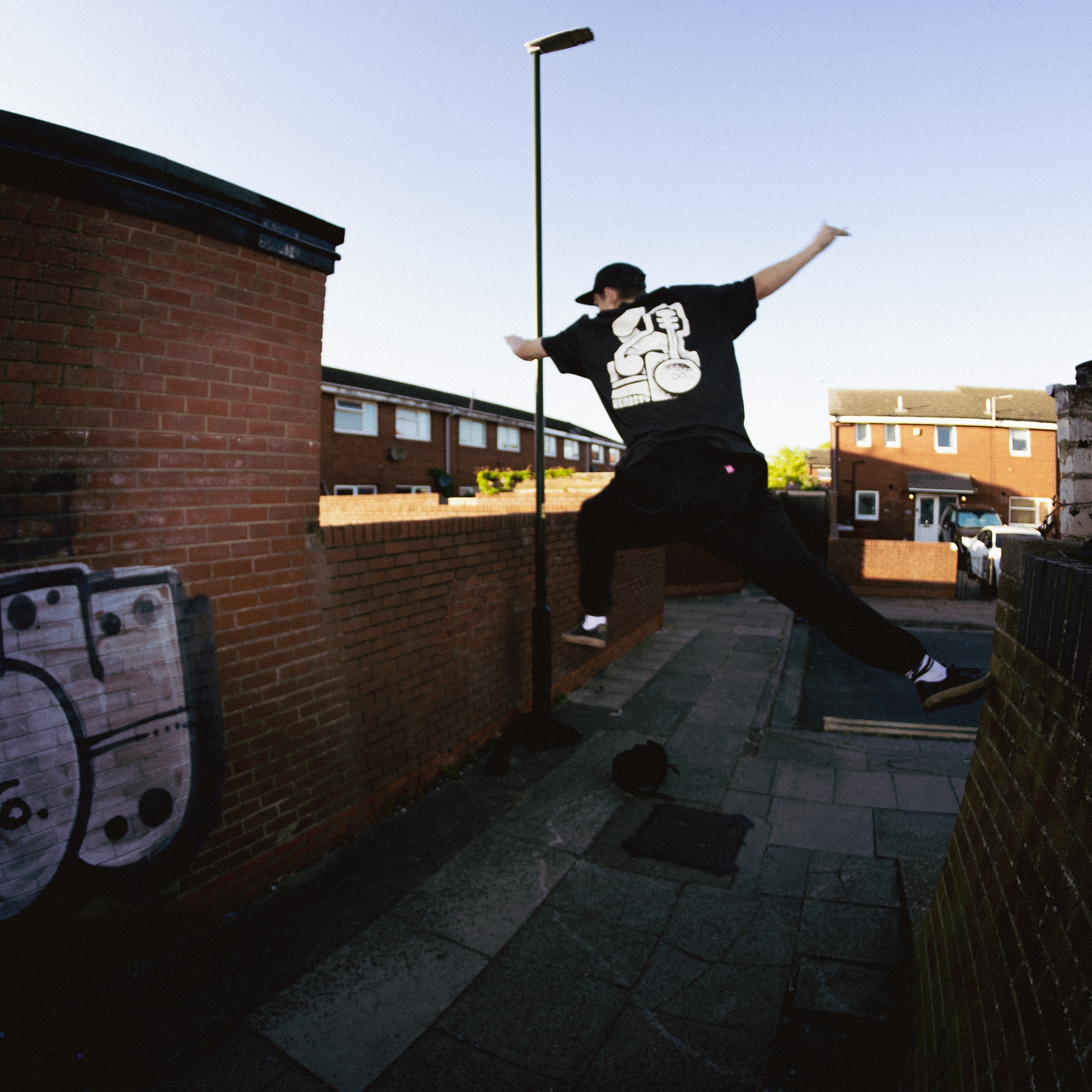
Parkour has changed a great deal over the past decade, and one of the most noticeable shifts has been the presence and influence of women within the discipline. Where it was once common for women to arrive at a session and find themselves in the minority, often navigating subtle assumptions about whether they truly belonged there, the landscape today feels markedly different. This change has not simply been about increased participation, but about a broader cultural shift in how parkour is understood, practiced, and shared. The experiences of two athletes from Femgaps, Georgia and Shannon, reflect this shift from different angles, shaped by very different entry points into the discipline.
Georgia began training around fifteen years ago, at a time when parkour communities were smaller, less structured, and overwhelmingly male-dominated. There were few established pathways into the sport for women, and little in the way of visible role models or dedicated spaces. Her introduction to parkour came almost by chance while she was living in Florence, after being shown a video of someone moving fluidly through an environment in a way that felt almost like dance. Despite not having a strong sporting background, she was drawn to the idea of movement as expression, even though the early stages of training were challenging. Progress was slow, and basic strength was initially a barrier, but the small community she trained with played an important role in making the experience feel accessible rather than exclusionary.
At the time, Georgia was also dealing with low mood and depression, and parkour gradually became more than just a physical activity. Training outdoors, often in difficult conditions, provided a sense of routine and focus that extended beyond the sessions themselves. The social aspect of the community also became significant, offering a sense of belonging that supported her through that period. A few years into her training, she began incorporating structured strength work, which marked a turning point in how she experienced parkour. As her physical capacity improved, movements that once felt unattainable began to open up, and her confidence grew alongside her strength. Over time, this progression led her into coaching, working across different countries and eventually establishing her own practice supporting women in both strength training and parkour. Her perspective reflects not only how the discipline has evolved, but also how individuals have actively shaped that change through their continued presence and contribution.
Shannon’s experience, by contrast, reflects a more recent and increasingly common route into parkour. Her background in aerial silks meant that she already had a foundation of strength, coordination, and comfort with movement in space, but parkour itself was not something she initially set out to pursue. Her introduction came through proximity to the community, spending time around training sessions and gradually becoming familiar with the environment. A key moment in her experience was seeing another female athlete, Flora, move with a level of confidence and control that made participation feel tangible rather than abstract. That sense of representation played a crucial role in shifting her perception of what was possible.
Once she began training, her progression was relatively rapid, moving from learning basic techniques and terminology to entering a London-based competition within a matter of months. Her performance in that setting, which included committing to movements involving real consequence, marked a significant shift in her own understanding of her capabilities. What stands out in Shannon’s account is not simply the speed of progression, but the way in which parkour reshaped her relationship with challenge and risk. The process of gradually expanding her comfort zone, supported by the community around her, mirrors a broader pattern within the discipline, where growth is often driven by exposure, encouragement, and incremental experience rather than predefined pathways.
Taken together, Georgia and Shannon’s experiences highlight both how much has changed and how certain core aspects of parkour remain consistent. There are now more visible entry points for women, including dedicated sessions, female-led coaching, and a wider range of role models, all of which contribute to making the discipline more accessible. At the same time, the underlying process of learning to navigate fear, develop physical competence, and build confidence through movement continues to define the experience. The diversity of backgrounds that women now bring into parkour, from dance and climbing to strength training or no prior sport at all, has also broadened the ways in which the discipline is practiced and understood.
Importantly, the presence of women in parkour has not been about adapting to an existing model, but about contributing to its evolution. The emphasis often placed on communication, mutual support, and long-term progression reflects a shift in values as much as in participation. Moments of encouragement, shared problem-solving, and collective progression are as central to the experience as the movements themselves, and these aspects shape how individuals engage with both challenge and community.
For both Georgia and Shannon, parkour represents more than physical skill development. It offers a framework for understanding one’s own capabilities, managing fear, and developing trust in the body over time. These experiences extend beyond training environments, influencing how individuals approach uncertainty and challenge more broadly. As more women continue to enter and shape the discipline, the visibility of these experiences becomes increasingly important, not only for those currently training but also for those who are considering starting.
The next generation of athletes will encounter a version of parkour where female participation is no longer unusual, and where a range of experiences and identities are already embedded within the community. While that shift may feel natural to them, it is built on the contributions of individuals like Georgia and Shannon, whose journeys reflect both the challenges of earlier participation and the opportunities that now exist. In this sense, the evolution of women in parkour is not simply a story of increased representation, but of ongoing change shaped by those who continue to show up, train, and contribute to the space in their own ways.

.jpg)