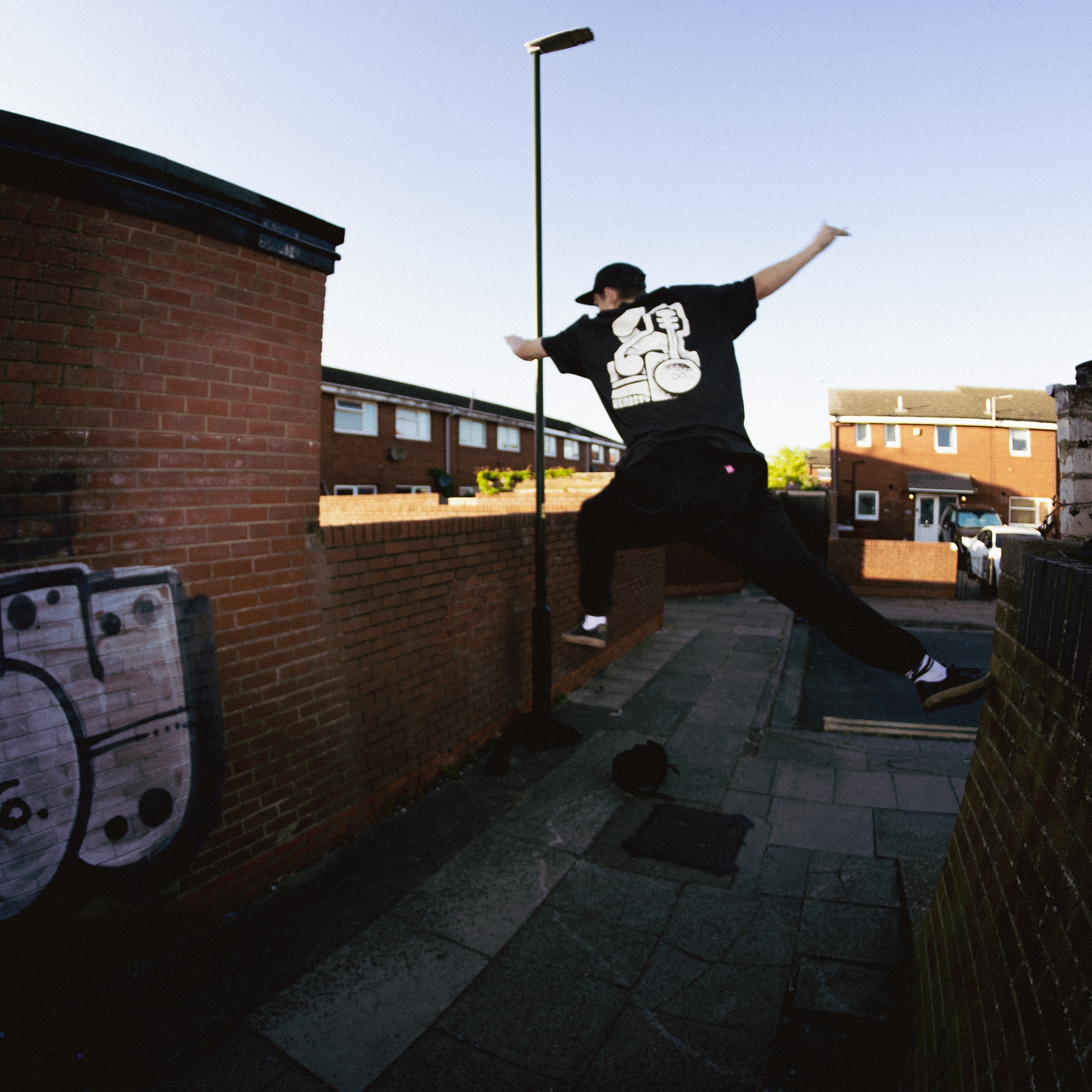
Parkour began with a group of young men training in Lisses, France, in the late 1980s. During those early years, very few women were involved. In interviews, founders Chau Belle and Williams Belle have mentioned that their aunts would occasionally train with them, and their younger sister Katty was also a regular at some sessions.
So while women were present in the earliest days of parkour, they were rare. Most of them, for one reason or another, eventually stopped training.
In the early 2000s, parkour began to spread rapidly following the release of Jump London (2003) and Jump Britain (2005), two Channel 4 documentaries that helped put the discipline on the map. Around this time, parkour classes started appearing across London. Several key women played an important role in growing female participation, including Shirley Darlington-Rowat, Fizz Hood, and Annty Marais. Regular outdoor classes began taking place across the city, including sessions specifically for women. Elephant & Castle became a popular training spot and was the location for Movement of Three, a well-known parkour film by Julie Angel that shows three women training together with a sense of fun, creativity, and playfulness. Since those early days, a lot has changed. However, parkour remains a predominantly male sport.
It’s important to highlight that within the parkour community, men are generally very supportive of women and want to see them succeed and thrive in the sport. Female participation has certainly grown since the early 2000s. One notable moment was the early years of Women’s International Parkour Weekend (WIPW), led by coaches Shirley Darlington-Rowat, Naomi Honey, and Annty Marais. In 2014, the event brought together more than 70 women in London to train together.
Social media has also helped increase the visibility of women in parkour. Many female athletes now share their training on Instagram, and brands such as Red Bull sponsor athletes including Hazal Nehir (Turkey) and Lilou Ruel (France). Parkour gyms have also reported an increase in girls attending classes over the past decade, suggesting that more young women are beginning to enter the sport.
However, some barriers to participation still remain. Many adult women who start parkour eventually leave the sport due to factors such as family responsibilities, time constraints, injuries, travel costs to gyms, or a lack of supportive local community and indoor training spaces. Some also report challenges such as limited representation of older women in the sport, events that do not actively create welcoming messaging for women, and coaching environments that lack emotional awareness. Coaches also observe a noticeable drop-off in participation among girls around the ages of 10–13. While many girls enjoy parkour between the ages of 4–10, puberty often coincides with increased self-consciousness, comments from peers, changes in physiology, and the challenges of training in a male-dominated environment. A lack of visible female role models and female coaches may also contribute to this decline.
Addressing these challenges requires greater visibility, better support, and stronger representation within the sport. While there are many inspiring female role models within parkour communities, they rarely receive the same public attention as prominent male groups such as Storror. Increasing the visibility of female athletes could play an important role in helping young girls see parkour as a sport they belong in.
Education and supportive coaching are also crucial during adolescence. Physiological changes during puberty — including increases in body fat and shifts in body composition — can temporarily affect performance in activities such as jumping. Without explanation, this can be discouraging for young girls. However, with the right coaching, training, and positive messaging, girls can continue to develop high levels of athletic performance, as seen across many other sports.
Perhaps the most practical step forward is increasing the number of female parkour coaches in the UK. Female coaches provide visible role models and can help create environments where girls feel comfortable and supported. Gym owners and coaching organisations should actively consider how they can recruit and develop female coaches, or invite external female coaches to run guest sessions where local representation is limited.
There are reasons to be optimistic about the future of women in parkour. In February, the event Ladies in Leuven took place at Hal5 Parkour Gym in Belgium and brought together 45 women from across the world. The event sold out, with people even waiting at the door in the hope of securing a last-minute spot. Part of the success of the event can be traced back to the gym’s commitment to female coaching. Three years ago, Hal5 hired three female coaches — Rachel Gough (UK), Louise Kilstrup (Denmark), and Camila Stefaniu (Brazil). None of them were living in Belgium at the time, but they moved there for the role and are all still coaching at the gym today. They now run a weekly girls’ class every Thursday that attracts around 20–24 students, ranging in age from 12 to 62.
The event also placed visible female role models at the centre of the experience by inviting world-class athletes Miranda Tibbling (Sweden) and Hazal Nehir (Turkey). Seeing high-level female athletes in person can be incredibly powerful. As one student put it: “I had been watching Storror for years, but when I watched Gatecrashers, that was the moment I realised — I need to do this.”
Accessibility also played a role. Tickets cost just €10, likely subsidised by the gym, making the event affordable and accessible to more participants. Many women prefer coached environments over open jams, and many also feel more comfortable being coached by other women. Events like Ladies in Leuven create spaces where women can develop their training, share experiences, and build community.
Parkour gym owners play a key role in enabling these opportunities. While many factors influence participation, this event highlights how impactful female-led coaching and events can be. Increasing the number of female-run programmes, creating mixed coaching teams, and raising the visibility of female role models will all help more girls and women find their place in parkour.
Participation grows when representation grows.
Written by Georgia Donati Clarke.

.jpg)