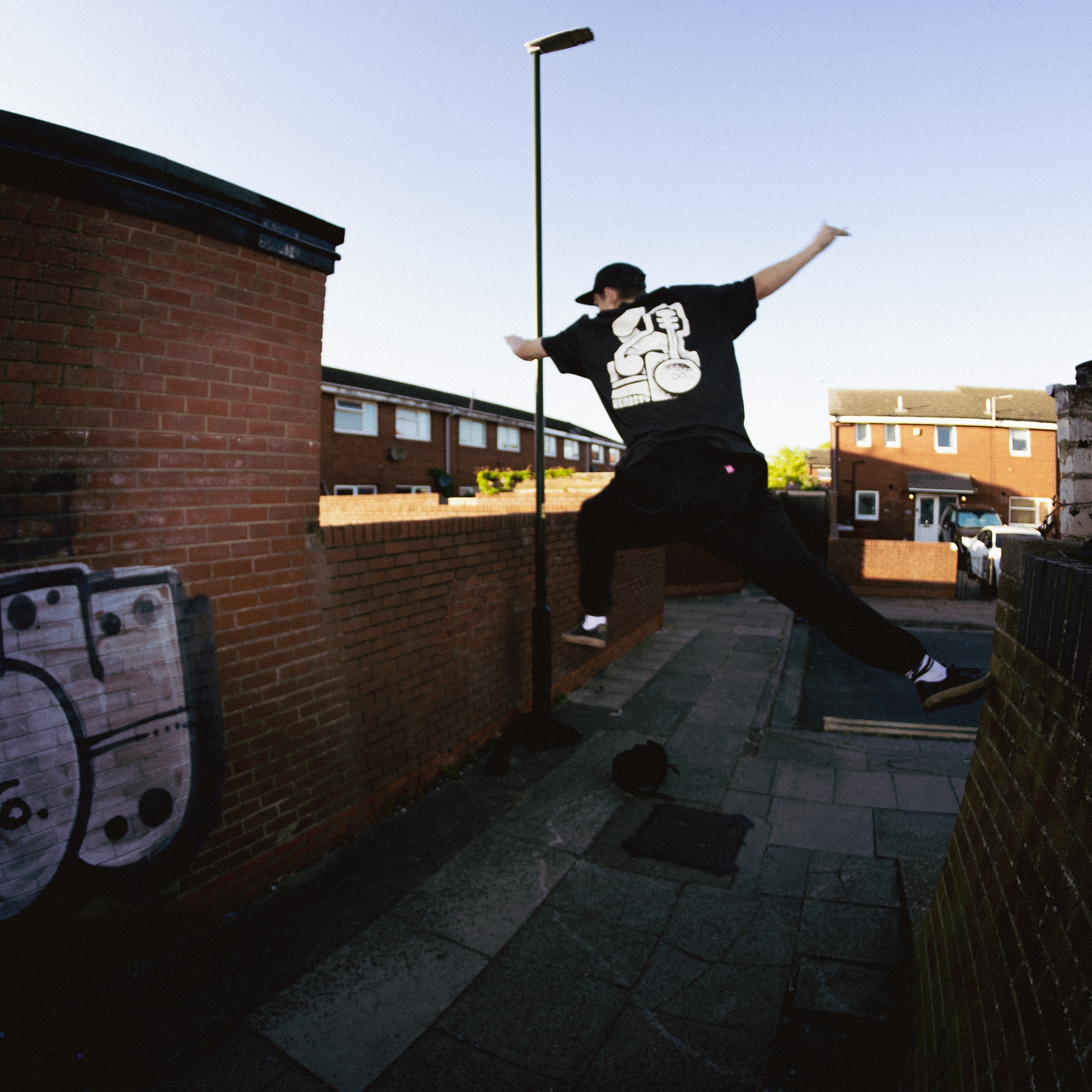
Spend enough time at parkour jams around the UK and you start to notice something. The spots change. The weather changes. But the people are strangely consistent...
Across different cities it's the same characters. The same conversations happening in slightly different accents. This isn’t a bad thing. It’s part of what makes jams feel familiar, no matter where you are. Turn up anywhere in the country and within ten minutes you’ll know exactly who’s who. Over time, you start to recognise the archetypes.
He’s been training longer than you’ve been aware parkour exists. The kind of person who references sessions from 2009 with names you’ve never heard of, but he insists were legends of the sport. You nod along, pretending you recognise at least one of them.
At some point mid-jam, he’ll stop you—usually just as you’re about to try something—and ask what you think parkour really is. This is a trap. There is no correct answer, and whatever you say will be gently, but firmly, unpacked over the next ten minutes.
He has strong opinions about everything: shoes, surfaces, techniques, and especially the direction of the discipline. Competition? Not for him. Pole slides? Questionable. Splats? Don’t get him started. Monetisation? Complicated. Jeans? Absolutely not.
His perspectives are never hostile. But they are inevitable.
You might only see them for about 20% of the jam. The first 10% when they turn up halfway through and the other 10% at the afterparty. You might catch them prepping something off in a corner. But before long, they’ve vanished. Then, half an hour later, a clip hits your feed. They’ve just kong gainered to a pole slide and completely redefined the sport.
The clip is insanely clean. How? Nobody knows. They just seem to be able to do these things.
The strange thing is, they don’t really train anymore. Not in any recognisable sense. No repetition, no visible progression, no “one more go.” You’ve never seen them fail at something twice. You’re not even sure they can fail anymore.
They think they’re blending in. They are not blending in.
There are signs. Subtle at first. A suspiciously clean swingthrough cork. Ending every line with touchdown raiz double cork. Too many lazy vaults. Movements that feel just a bit too floaty, a little too precise. At some point, they’ll casually mention, “I used to do a bit of tricking” . They did not do a bit.
You don’t need confirmation. You can tell. Everybody can tell.
Pure commitment. Questionable margins.
This is the person who says, “I think I’ve got it,” about something they very clearly do not have. The kind of athlete who seems to operate on a completely different threshold of risk.
There’s a philosophical edge to it as well. If a tree falls in the woods and nobody is around to hear it… My point is, someone needs to be watching.
It’s hard to tell whether they’re brave or just slightly off in their judgement of distance and consequence. Probably both.
They’ll land something outrageous once—something genuinely impressive—and then, almost as a rule, never do it again.
Occasionally, you’ll see them taking photos with those German blokes with the mullets.
They are powered entirely by hype. Every jam has one, and every jam keeps a cautious eye on them.
They didn’t start in parkour—but they’ve arrived fully equipped.
You’ll recognise them immediately. Barefoot shoes, regardless of the weather. A sort of gorp-core, athleisure hybrid aesthetic that implies wealth. Often found slightly off to the side, holding a handstand for no obvious reason. Their warm-up alone can last longer than most people’s entire session.
They might not be sending the biggest lines just yet, but it doesn’t really matter. Their joints are indestructible, their control is ridiculous, and they move with a kind of precision that suggests long-term investment.
They’ll probably still be training in ten years. It’s not strictly parkour… but give it time.
What’s interesting about these archetypes isn’t just that they’re recognisable, but rather that they say something about what parkour has become.
For a long time (long ago), parkour presented itself as a kind of unified philosophy. A shared set of ideas about movement, discipline, and how to engage with urban environments. But if you spend any real time with the sport, that philosophy feels less like a rule and more like a loose starting point. From there, people branch off in very different directions.
Some hold onto older ideas and protect them. Some translate parkour into visibility, content, and career. Some blend it with other movement cultures. Some push risk. Some refine technique. None of them are necessarily wrong, they’re just emphasising different parts of the same thing.
Parkour isn’t just one practice anymore. It’s a space where different interpretations coexist, overlap, and occasionally clash. The Old-Head questioning the direction of the discipline. The Attention Economist redefining what success looks like. The Movement Transplant bringing in entirely new priorities. The Send Merchant stress-testing the limits of what’s acceptable. The Tricker quietly reshaping aesthetic trends.
A jam, in that sense, isn’t just a training session. It’s a meeting point between all of these perspectives, whether people realise it or not.
These archetypes are snapshots of parkour's history and present. It's fragmented and evolving. In the future, I hope to see new archetypes evolve and emerge (I personally see myself as a sort of neo-unc of the motus era).

.jpg)