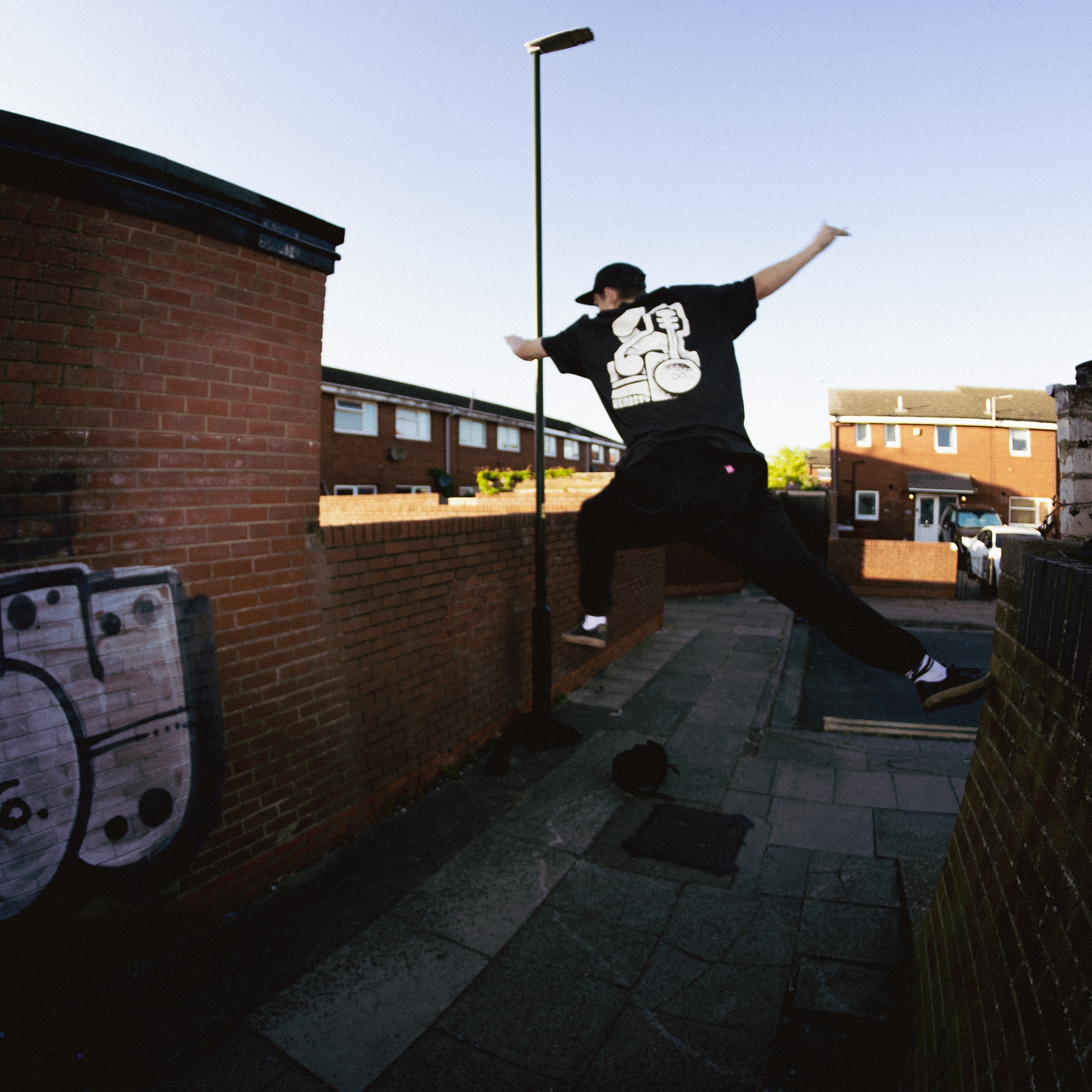
As parkourists, we’re all too familiar with the feeling of someone shouting “parkour” at us while we train. Indeed, this tradition follows in a long lineage of passers-by shouting, “do a kickflip” and singing Avril Lavigne’s Sk8er Boi at other youths practicing urban sports. But why do people shout it at us? Is it provocation, or something else? In this article we’ll dive into ‘parkour’, the meme. This article was inspired by a book chapter of the same name by Callum Powell. If you’re unsatisfied by my perspective and want a deeper dive into parkour and popular media then I’d suggest you buy his book!
For those that don’t know, the “parkour” meme comes from a cold-open (a sort of stand-alone skit) in an episode of the office. The skit shows characters running around the office performing clumsy jumps while shouting “Parkour!”. The skit parodies real parkour by replacing skill and precision with chaotic, overconfident movement. Given how widely loved The Office is (and, in my opinion, superior to the original UK version), it’s no surprise this moment stuck. It’s simple, repeatable, and instantly recognisable. Whether by design or not, the skit was perfect meme material.
But why do people shout it? To fully understand that I think we need to understand what a meme actually is. The term ‘meme’ comes from evolutionary biologist, Richard Dawkins’ 1976 book, The Selfish Gene (a surprisingly accessible, albeit rather dry read). In the book, Dawkins presents the argument that natural selection happens at the genetic level, rather than at the level of the organism. Put simply: Successful organisms are the product of successful genes.
This seems like a weird tangent, but stick with me. These genes, which give rise to successful organisms, need to replicate — but replication brings variation, and that variation leads to (natural) selection. While this seminal work transformed how we understand modern evolutionary biology, it also provides a useful template for understanding units of culture, that is, individual units of meaning that give rise to cultures. According to Dawkins, beliefs, catchphrases, rituals, and funny snippets of American sitcoms all function like genes. Things that people find salient, memorable, or useful tend to stick around and, provided these cultural units undergo replication and selection, they eventually give rise to culture as we know it.
So, memes are units of culture that replicate, get selected, and, over time, give rise to culture as we know it. “But Charlie,” I hear you ask, “why do people keep shouting ‘parkour’ at me?” Don’t worry—I’m getting to that.
Why I think people shout it at us is the same reason any of us engage in social behaviour at all—it comes down to Social Identity Theory (SIT). I’m not a social psychologist, so without getting too into the weeds, SIT suggests that we don’t just think of ourselves as individuals, but also as members of social groups (e.g., nationality, profession, sports teams). These group memberships shape how we see ourselves and others. A key idea is that people are motivated to maintain a positive self-image, which often leads them to favour their own group (the in-group) over others (the out-group). This can result in bias, stereotyping, and even discrimination, as individuals seek to boost their group’s status relative to others.
“Ah, so you think we’re being discriminated against!? Call the police — a hate crime has been committed!”
Whoa, hold on a second! Statistically speaking you’re a white male in your late teens or early twenties. Let’s not be so quick to play the victim.
What I think is happening is more complicated. They’re trying to make sense of what they’re seeing using the cultural tools available to them. The Office meme is often the only reference point they have that’s widely shared and immediately recognisable. It’s the quickest way for them to say, “I know what this is.” In doing so, they’re also reinforcing their own place within a broader cultural group — modern Western pop culture, loosely defined. It’s less about us, and more about them situating what they see within their own cultural framework.
Crucially, I could be wrong. People could shout it at us because they think that our sport is laughable, and that the office absolutely nailed what the sport looks like to an observer. However, as the sport ages through its awkward adolescence and into young adulthood, we can feel the cultural shackles of our formative years loosen. People these days are equally as likely to shout “Storror” as they are to shout “parkour”. Furthermore, even when people do shout “parkour”, they’re often doing so purely as an exclamation of recognition, rather than a reference to a skit (trust me, once you’ve heard it as much as we have you can tell the difference). What I’m saying is, the cultural landscape is changing. The meme’s salience is fading, and with it the meme is losing its grip on culture, gradually being replaced by newer, more accurate reference points.
Ultimately, being shouted at isn’t really about disrespect, it’s about recognition filtered through cultural touch-points. People reach for the most familiar reference they have, even if it’s outdated or imperfect. As parkour continues to grow, those references will evolve, becoming more aligned with what the sport actually is. Until then, “parkour!” is less an insult and more a sign that, in some small way, what we do has made it into the shared language of culture — and that’s not so bad!
.jpg)