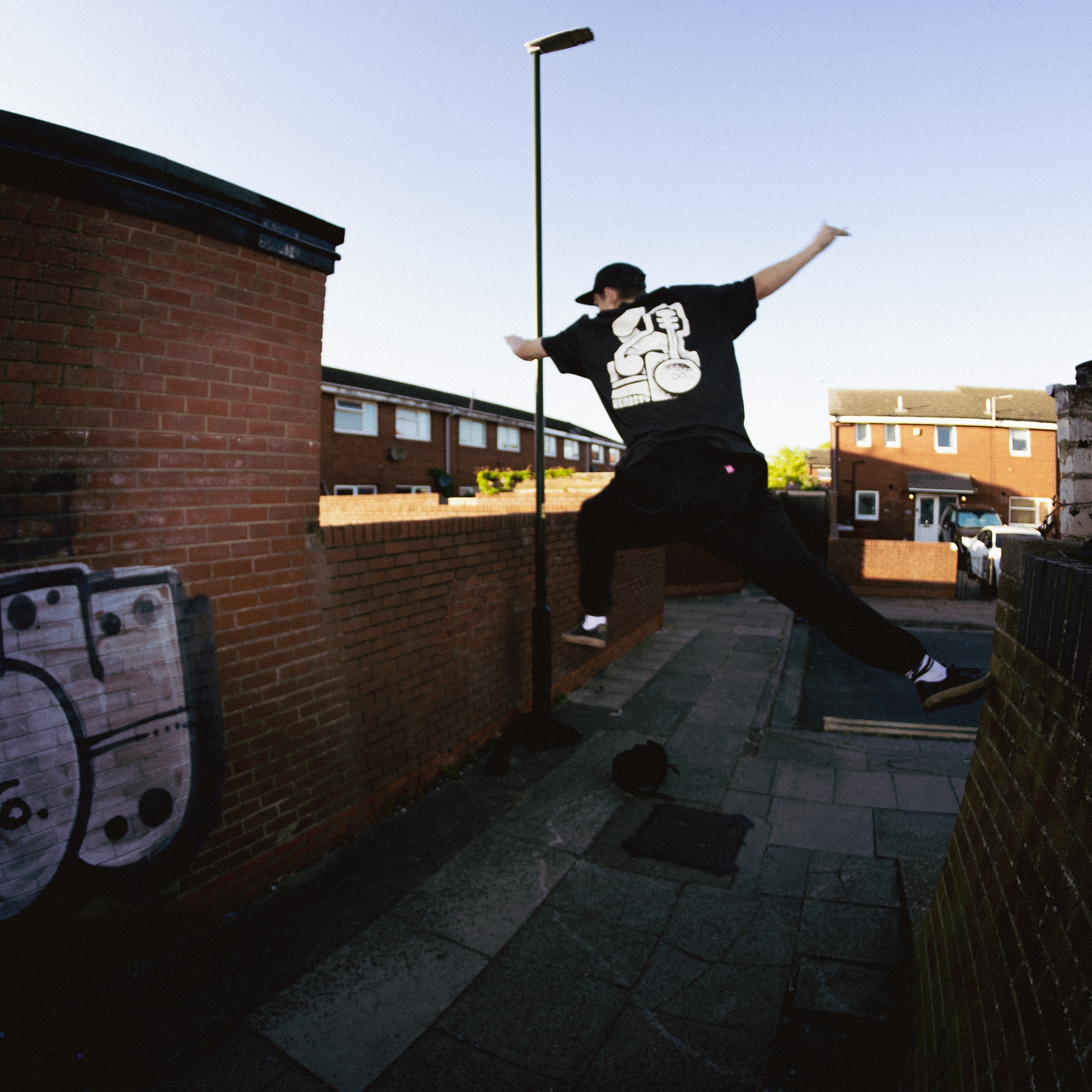
Photography plays a vital role in how parkour is experienced, understood, and remembered. It allows moments of movement to be distilled into something lasting — images that carry intention, creativity, and cultural meaning beyond the instant they were captured. Through photography, parkour is documented, curated, and communicated in ways that shape how the discipline is perceived both within and beyond its community.
Parkour has always been more than movement. From its earliest days, the discipline has been shaped, shared, and understood through media — photographs and videos provide visual storytelling that captures not just what parkour looks like, but what it feels like. Many people think of parkour videos as the main form of documenting and sharing parkour (and they'd be right), but among these mediums, photography holds a unique place in the sport. Photographs freeze moments of intention, effort, and connection between practitioner and environment, offering a highly distilled insight into the sport that a clip alone may struggle to provide.
Parkour photography, unlike parkour videography, is not about documenting impressive movements. It is about interpretation, perspective, and understanding — of space, of timing, and of the practitioner’s relationship with their surroundings. While it shares surface-level similarities with other action or street-based photography genres, parkour photography has developed its own visual language, shaped by the specificity of movement, urban environments, and the culture that surrounds the discipline. As parkour continues to grow and evolve, photography remains one of the most powerful ways to represent its values, connect communities, and communicate its identity to the wider world.
In this article, we have the pleasure of sharing a perspective on parkour photography from Jack Dodds, a founding father of modern parkour photography and current photographer, videographer and content manager for the parkour media giant, Storror.
Parkour photography, though sharing similarities with other photographic genres such as skateboarding and action sports photography, has its own methods, environments and styles that separate it in many ways to that of different photography genres. The sport of parkour is often practiced in an urban environment, and although definitely not restricted to this, this means that elements of street photography can often become synonymous with parkour photography, and contain styles of portraiture and architectural which are often also seen within the genre of street photography.
A functional use of parkour photography is the documentation of events that happened. This can be a jump or movement captured by the photographer and expressed in an artistic way, or a portrait of a parkour practitioner or environment in which parkour is practiced. The function of this is truly subjective to the viewer; however, one thing for certain is that being able to represent parkour culture in varying mediums is an important pursuit for our practice to continue growing and to spread its message.
Parkour photography is a great way of engaging with the parkour community in a way which doesn't necessarily involve practicing the sport yourself. Photography is an incredibly powerful tool not only as a documentation of events, as stated previously, but also as a way of engaging with communities in a creative way. The fundamentals of parkour were built somewhat on free thinking, and this is equally represented through photography, allowing the photographer to use their perspective to capture nuanced moments in time and events within the sport.
Parkour was popularised largely out of media — tv, photo, video and social media — and it has always been important for the sports progression and the sharing of ideas and values. This can only continue with enthusiastic media makers, photographers, filmers and artists within our sport to carry and represent this message to the coming generations.
Parkour photography differs from similar photography styles largely because of parkour's specificity of using the body to create movements in an environment. For example, it is important to show the practitioner's face in the image of an action photo, because this creates a connection to the viewer, gives a reference point for people to understand what is going on and gives context to who that person is in the image. This means that if you don't understand the movements you're photographing, it is entirely luck if you get the practitioner's face in the frame.
Put simply, it is important to comprehend parkour movements when shooting parkour photos. Henri Cartier-Bresson was a French master of street photography, and conceptualised the theory of 'The Decisive Moment', which basically stated how in any given situation, there is a precise moment in which it makes the most sense to take a photograph. This could be the moment in which a bird flies into an open space on a nature photographer's frame, or when a unique character moves perfectly into a beam of light on a street photographer's frame. This theory can of course, also be applied to parkour photography, especially when the photographer is able to understand the movements of the parkour practitioner. They are able to understand the perfect moment in which a practitioner reaches full extension in a double kong, or the most aesthetic airform during a flip. This is generally the best moment to shoot a photo.
As much as freedom and personal practice is so important in cultivating your own style within photography, much the same as in parkour, it is equally important to understand fundamentals such as Herni Cartier-Bresson's, as these give us a foundation to build from. Rules must be understood before they can be broken with any level of effectiveness.
The importance of photography, as opposed to other artistic mediums which represent the sport, cannot be understated. The past 20 years has seen dramatic decline in the popularity and usage of magazines and print photos globally, which have been dominated by the internet, and social media at large. This change in media consumption occurred simultaneously with the growth of parkour, and has meant that being able to share high quality media of parkour has a huge amount of significance in our sport, and is also why it is able to evolve at such a fast and unpredictable way. The high-rate sharing of ideas lends itself to quick progression.
Photography at its core is a creative pursuit. As much as photography represents a moment in time, it is synonymous with creative thinking and some level of input and intention from the photographer. This is not always the case with video, for example, much of which is used purely for documentation purposes direct from the practitioner themselves and, aside from creative and long form video projects, often lacks a level of creative input from the filmer. Photography, therefore, holds importance within our community as a way in which parkour can be showcased or idealised. It is a selection process in which the photographer decides a moment in time noteworthy, interesting or unique, or somewhat valuable. That is the power and the voice of a photographer.
The wider audience of parkour may find a connection to the sport through photography, much in the same way that other forms of art reach us and have an influence on our daily lives, and this shows the true importance of photography within parkour.
Photography plays a vital role in how parkour is experienced, understood, and remembered. It allows moments of movement to be distilled into something lasting — images that carry intention, creativity, and cultural meaning beyond the instant they were captured. Through photography, parkour is documented, curated, and communicated in ways that shape how the discipline is perceived both within and beyond its community.
As parkour continues to develop in an increasingly digital and visual world, the role of photographers becomes ever more important. Their understanding of movement, timing, and environment allows them to capture the decisive moments that define the practice, while their creative choices help articulate parkour’s values of freedom, adaptability, and expression. In this way, parkour photography is not secondary to the discipline — it is an integral part of its cultural ecosystem, helping to inspire participation, preserve history, and carry the spirit of parkour forward to future generations.

.jpg)